
The rising cost of meta ads – and why it’s a problem for nonprofits
If your charity relies on Meta ads to attract donations, fundraisers, legacy giving leads, or campaign supporters, you’ve probably already felt the impact of rising advertising costs.
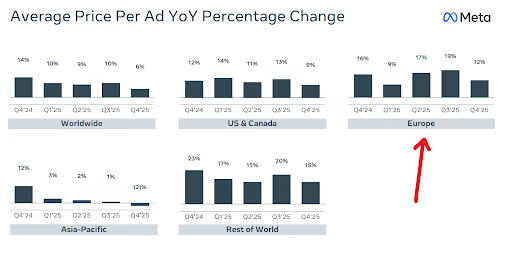
Meta’s Q4 2025 earnings report (I read these things so you don’t have to) revealed an average of over 14% increase in the average cost per ad served in Europe last year. In our review of 2024’s Earnings Presentation we predicted a CPM rise between 10-15% in 2025, and as upsetting as it is to have predicted correctly, assuming the trend continues in 2026, as it has done for almost 3 years running, charities could reasonably expect a further 10-15% rise. That means your cost-per-acquisition (CPA) will increase (and your ROI will fall) unless you improve conversion rates (CVR).
However, rising CPMs are only part of the challenge. Starting in Spring 2026, Meta is introducing “Location Fees”, additional surcharges on ads delivered in specific countries to offset local taxes, such as Digital Services Taxes (DST). How nice of them, we all get to pay Meta’s tax bill!
What are the Location Fees?
Unlike your standard CPM, these fees are added to your bill as a separate surcharge based on where your ads are delivered.
- How it works: The fee is determined by where the ad impression occurs, not where your charity is based. If a UK-based charity serves an ad to a supporter in the UK, a 2% fee will be tacked onto that spend.
- The Rates:
- United Kingdom: 2%
- France, Italy, and Spain: 3%
- Austria and Turkey: 5%
- The “Invisible” Cost: These fees typically do not show up in your real-time Ads Manager metrics; they are added to your final invoice. This means your actual CPA is higher than what your dashboard is telling you.
The Double Threat: Rising CPMs and New Location Fees
Simply put:
If your CPM rises by 15%, and in the UK you have to pay an additional 2% surcharge, you need to increase conversion rates by at least 17% just to keep your results the same 💡
For charities, this isn’t just a budget issue, it’s a threat to supporter engagement and fundraising efficiency. Rather than spending your way out of the problem with bigger media budgets or increased creative production, the smarter approach is to instigate Conversion Rate Optimisation (CRO) first.
What is CRO and why does it matter for charities?
CRO is about making your website, donation pages (and funnels), and sign-up forms work harder. Rather than just driving more traffic, you’re ensuring more of your visitors complete the desired action, whether that’s making a donation, signing up for an event, or pledging a Gift in a Will.
With rising ad costs, even a small increase in conversion rate (CVR) can have a massive impact on ROI. As an example:
If your current donation page converts at 3%, and Meta costs rise by 15%, you’ll need to increase CVR to 3.45% just to maintain efficiency
Stakeholder engagement & frameworks
To successfully implement CRO, cross-discipline collaboration is key. CRO requires input from multiple skillsets, including digital marketers, fundraisers, web developers, UX designers, data analysts, and leadership teams.
A structured approach ensures everyone is aligned on goals, priorities, and KPIs. Establishing clear processes for testing, measuring, and iterating helps create a culture of continuous improvement. By integrating CRO into broader digital strategies, charities can build scalable, repeatable frameworks that drive sustainable growth.
4 CRO tactics to protect your fundraising & campaign goals
1. Reduce friction on your donation & sign-up pages
- Ensure a seamless experience (especially mobile, most charity ad traffic comes from mobile users). Actually go and use your website, or even better ask a close friend or family member to do it too – you’ll be surprised at the obvious blockers that might be lurking.
- Cut unnecessary form fields and only ask for the essentials.
- Offer express checkout options (Apple Pay, PayPal, Google Pay) for faster donations.
- Use real-time validation to prevent errors and user frustration.
Charities that streamline donation forms see a 20-50% increase in completion rates.
2. Improve message match between ads & landing pages
- Make sure landing pages reflect ad messaging to maintain donor trust.
- Personalise donation asks based on audience segments (e.g., first-time vs. returning donors).
- Highlight impact-driven messaging, show how each donation makes a tangible difference. Review your storytelling and impact stories. Studies repeatedly show that storytelling is more likely to drive supporter action than pure stats and figures.
Meta’s ad algorithm prioritises relevant experiences—better alignment means lower CPCs and better ad performance.
3. Use AI & personalisation for smarter CRO
- Investigate emerging Gen AI-powered donation forms that suggest giving amounts based on user behaviour and context signals.
- Use heatmaps & session recordings to identify drop-off points and optimise page layouts. Hotjar has a free version to get started, but make sure your consent banners/policies are implemented correctly.
- Test nudge tools, such as progress bars for appeals or most common/recent donations tickers
- Implement dynamic content that adjusts based on visitor type (e.g., regular donors vs. one-time givers).
- Future-proof your personalisation by focusing on collecting explicit user preferences (zero-party data) and leveraging your internal CRM data (first-party data) for segmentation and AI model training.
A/B testing personalised donation pages can boost conversions by 30-40%.
4. Consider Omnichannel CRO
Extend conversion optimisation beyond the landing page to post-donation/post-sign-up journeys (thank-you pages, follow-up email sequences) to improve supporter lifetime value (LTV), all managed through a connected MarTech stack.
What charity marketers should do now
- Assume another 10-15% rise in Meta costs for 2026. Review budgets, forecasts and models (or reach out to us to help you build these if you don’t already have them!), and update targets/projections.
- Start conversations with senior budget holders. Investing in CRO now could deliver significantly better ROI than simply increasing media spend, or developing lots of new ads.
- Set expectations. Bring people around you on this journey – your organisation needs to be able to embrace the power of failure – 80% of AB tests might have no winner and that’s OK – learning what doesn’t work is just as important as learning what does.
- Pilot small CRO experiments. Even small changes—like reducing form fields or improving page speed—can yield major improvements in conversion rates.
- Benchmark. Capture what your conversion rates are like before you make a start, it’s nice to be able to show the impact of any ideas you’ve had and changes you might make, and it’s an incredibly useful way of justifying further investment.
Ready to future-proof your fundraising?
Instead of struggling with rising CPAs and declining efficiency, a strategic CRO investment can help your charity achieve more with less.
If you want expert help optimising your donation and registration journeys, then let’s chat.
Further reading
- If your charity’s Meta ads account has been affected by the recent restrictions based on sensitive content, take a look at our Digital Marketing Director’s thoughts in this area, and actions you can be thinking about now.
- We implemented a structured programme of CRO with our client Woodgreen Pets Charity to bring about a 62% increase in their Meta ad traffic in just 4 months, find out more about that project here: Woodgreen case study