
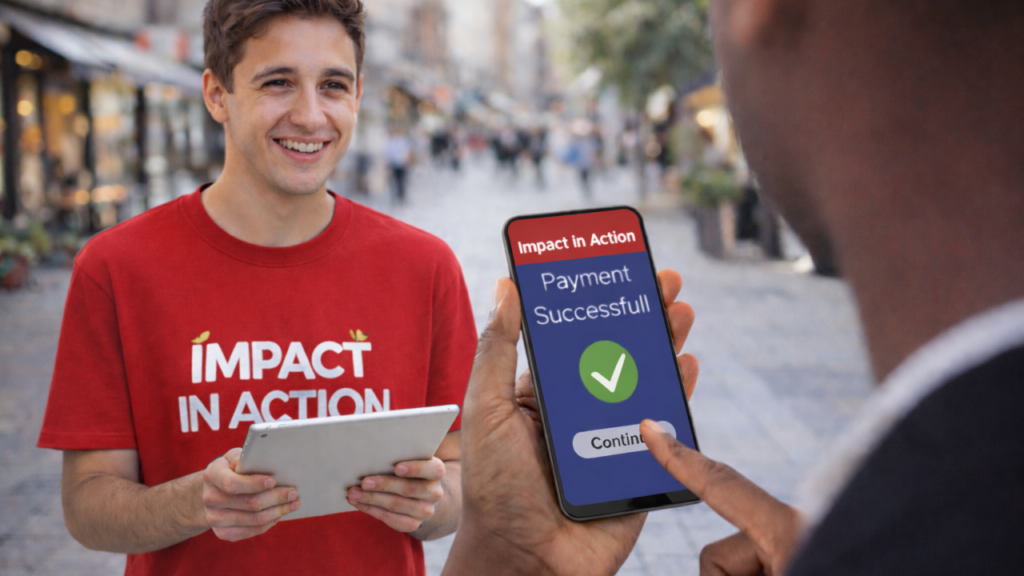
Why does a payment channel strategy drive better management, greater value creation and ultimately greater impact?
Because generosity starts with a “yes”… but value starts with a payment.
Over the past weeks I raised two uncomfortable questions about F2F fundraising:
• Why are we saying “No” to people who say “Yes” to donating?
• And Before blaming rising CPA, should we sometimes look first at training?
Today I want to highlight another structural lever that remains underestimated in F2F campaigns: Payment diversity and management.
Too many campaigns still operate with very limited payment options. But donors live in a multi-payment world : Direct Debit, Credit cards, Apple Pay, Google Pay, PayPal, etc… If your F2F fundraising campaign only accepts one or two methods, you are forcing donors to adapt to your system instead of adapting to theirs. And every friction point costs donations.
Why payment diversity matters for F2F performance : Payment is where generosity becomes value.
– More possibilities for donors: People simply don’t pay the same way anymore. Offering multiple payment channels means meeting donors where they are.
– Immediate first donations: Digital payments allow the first donation to happen instantly. This is critical because the F2F economic model often relies on confirmed “starter donors” (donors who have made at least one donation). Less delay = more secured value for NGOs and F2F providers.
– Smarter management of transaction costs: Each payment method comes with different banking fees and structures. Operating multiple channels allows NGOs to optimize the economics of transactions, if well managed with their F2F providers.
– Strategic channel management: Opening multiple channels doesn’t mean losing control. You can prioritize certain payment methods while still keeping others available. Manage them. Don’t exclude them.
– Better banking negotiation and flexibility: A diversified payment ecosystem gives NGOs more leverage with their banking partners. It also allows organizations to arbitrate their preferred channels based on banking fees or operational efficiency, without excluding other payment options. In short: Optimize without restricting.
– Align fundraising strategy with financial strategy: When payment channels are analyzed through data, LTV and ROI, fundraising teams start speaking the same language as finance teams. This helps break down the silos that often exist between fundraising departments and financial departments, creating a shared strategic approach to value creation.
– Reach every donor segment: Payment habits are often generational and behavioral. Some donors trust Direct Debit. Others prefer cards. Many younger donors rely on digital wallets. Limiting payment options means limiting your potential donor base.
– Strengthen compliance and transaction security: Modern payment technologies bring advanced fraud prevention, instant bank verification and strong banking compliance frameworks, protecting both donors and NGOs.
– Boost motivation in F2F teams: Payment diversity also has a very concrete impact in the field. When fundraisers know they can accept donations through multiple payment methods, they face a real universe of potential donors, not one artificially restricted by operational limitations. And that changes motivation, confidence and performance.
– What if rising F2F costs are not inevitable? A potential deflationary lever in an inflationary environment. Across many markets, Face-to-Face fundraising has experienced continuous cost inflation. Rising CPAs. Increasing operational costs. Growing pressure on campaign profitability. Yet payment fluidity and access to a wider range of payment channels can significantly improve the profitability of every hour worked by fundraisers in the field. By reducing friction and enabling immediate transactions, payment diversity and management increases the value generated per interaction. For the first time, the strategic management of payment channels may represent a genuine deflationary lever for a fundraising channel that remains strategically essential for NGOs worldwide.
Payment channels are not just a technical feature. They are a management strategy. A value strategy. An impact strategy.
More payment options means less friction, faster first donations, better cost control, broader donor reach, stronger alignment between fundraising and finance, more motivated field teams
In short: Stop limiting payment options and you unlock the full potential of F2F fundraising and build greater impact.
Question for the F2F community: Are we still underestimating how much payment channel strategy can improve campaign performance? Curious to hear how NGOs and F2F providers are approaching this today.lone, but by how seriously we choose to invest in the people who carry the channel every day.