
On any given day in the charity sector, fundraisers are doing a lot of emotional and practical heavy lifting.
They are juggling targets, stewarding donors, holding stories of trauma, and trying to raise money in a cost of living crisis. Enthuse’s Donor Pulse Spring 2024 shows that over half of people still feel it is harder to give than it was six months ago, even as inflation eases.enthuse.com At the same time, CAF’s UK Giving 2025 report finds that only around half of UK adults are now donating, down from 58 percent in 2019, which equates to roughly four million fewer donors. CAF Online
In short, everyone is under pressure. Which is exactly why safe, inclusive workplaces for queer and trans fundraisers cannot be treated as a side project or a “nice to have”. They are central to whether your organisation can attract and keep brilliant people and whether your fundraising actually works.
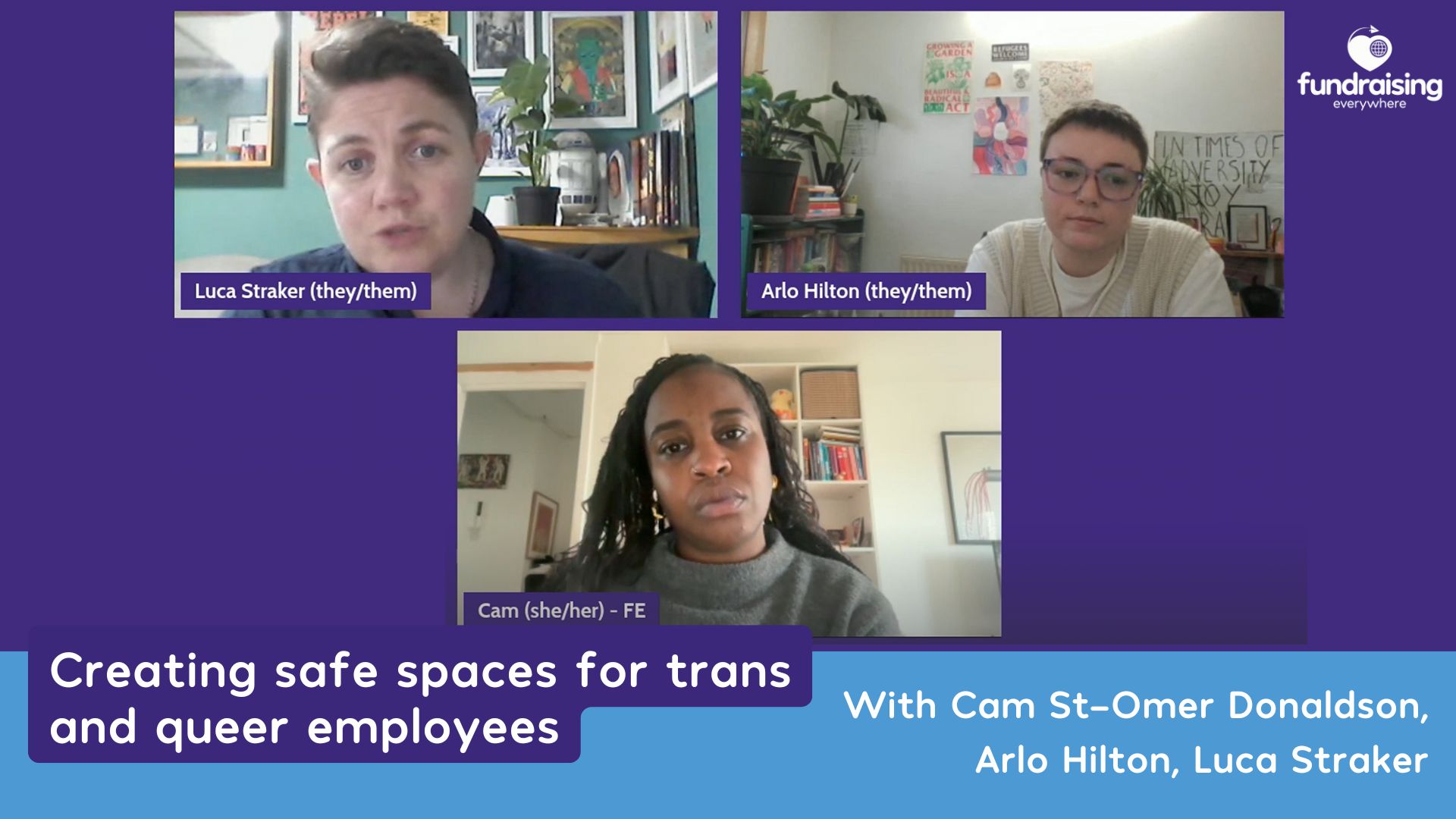
This blog is based on a session from the Fundraising Culture & Change On Demand Programme, which is a conversation between Cam St Omer-Donaldson (she/her), Head of Membership Engagement, and guests Luca Straker (they/them), CEO of Proud Changemakers, and Arlo Hilton (they/them), a partnerships and inclusion specialist. It digs into what it really looks and feels like to create safe spaces for queer and trans colleagues, and how you can move from policy on paper to culture in practice.
Today’s focus is on queer and trans staff, but many of the ideas here will support everyone on your team.
Why this matters for fundraising, not “just” HR
Fundraising leaders are already worried about resource, income and retention. Open’s Charity Benchmarks 2024 highlights that since 2023, participating charities saw income rise by only £1 million while spend went up by 4 percent, meaning many are spending more to raise less. Open Regular giving and online income dipped, while expectations on teams kept rising.
Layer onto that:
- Fewer donors overall in the UK
- Supporters who are more selective, and quick to disengage when trust is broken enthuse.com
- A sector-wide need to “do something new” and avoid stagnation Open
If your queer and trans fundraisers are spending a big chunk of their brain space worrying about safety in the office or at events, they do not have that energy available for donors, campaigns, or innovation.
As Luca put it in our session, trans and non-binary people are often silently doing extra emotional calculations throughout the day:
- “Will I be misgendered in this meeting?”
- “Is it safe to correct someone?”
- “If I challenge this, will it affect my credibility with a funder or senior leader?”
If you are not constantly doing those calculations about your gender or safety at work, that is part of cis privilege. The goal is not guilt. The goal is to notice those differences and use your power to make things fairer.
Creating safer spaces is not just about “being nice”. It directly affects:
- Retention: people stay where they feel safe and respected.
- Performance: safe people do better work. That is true for everyone, but the safety bar is higher for marginalised staff.
Reputation: supporters increasingly look for charities that live their values, not just talk about them. Enthuse’s research shows trust is generally high, but fragile, and can be knocked by harmful narratives.enthuse.com
Cis privilege at work: a quick reset
Before we zoom into policies and checklists, it helps to ground ourselves in what cis privilege can look like in a day-to-day charity office.
If you are cis, you probably do not have to worry about questions like:
- “Will my colleagues ask invasive questions about my body over lunch?”
- “Will someone at an away day ‘joke’ about my gender in front of a donor?”
- “If I add my pronouns to my email signature, will that start a debate about my existence?”
For many trans and non-binary people, those possibilities are not abstract. They are part of the mental risk assessment they run in every new space.
Cis privilege at work can look like:
- Assuming you will be called by the right name and pronouns without having to ask.
- Knowing no one will ask about your genitals in the office and see it as fair game.
- Not having your competence questioned because of how you dress or which toilets you use.
This does not mean you are a bad person if you hold that privilege. It means you have extra “brain space” available. If you are a manager, trustee, or senior fundraiser, you also have positional power. How you use both will shape how safe your workplace feels for queer and trans colleagues.
Policy is a starting point, not a finish line
Lots of organisations now have equality, diversity and inclusion statements. Some have transitioning at work policies. Fewer have moved that work into the day-to-day reality of team culture.
What a good transitioning at work policy does
From Luca’s experience supporting charities, and from their own transition at work, the most useful policies tend to be:
- Explicit, not vague. Avoid woolly phrasing that leaves space for individual bias. Spell out what happens with things like email addresses, records, uniforms, security passes and comms.
- Co-created with trans staff or trusted experts. The person transitioning should not have to write their own policy from scratch, but their lived experience is vital in shaping it.
- Clear on leave and pay. Surgery or other medical appointments should not be treated as “sickness”. Trans people are not ill because they are trans. Make it paid leave, be explicit about how much, and ensure it does not count against them in absence reviews.
- Recognising diversity of transition. Not every trans person will change their name, pronouns, presentation, or access medical interventions. The policy needs flexibility rather than a single “route”.
Robust, specific policies matter because they remove room for interpretation. If the process depends on whether an individual manager “gets it” or not, you are at risk.
The Code of Fundraising Practice and duty of care
This is not only an internal HR question. The 2025 Code of Fundraising Practice, which applies to staff, volunteers and third party fundraisers, now places stronger emphasis on safeguarding people involved in fundraising. Charities are expected to take reasonable steps to protect fundraisers from harm and harassment, and to put clear routes in place for reporting and support.muslimcharitiesforum.org.uk
NCVO’s safeguarding guidance for fundraising roles echoes this. It asks charities to think explicitly about how they are meeting their duty of care for staff and volunteers, what guidance and supervision they need, and how to handle inappropriate behaviour at events.NCVO
If your policies do not mention trans and queer staff at all, or treat harassment based on gender identity as a minor “issue” to smooth over, you are not aligned with either best practice or public expectation.
Turning policy into culture: what good managers actually do
In the session, Arlo shared examples of managers who used their positional power well, and where it fell short.
Here are some of the practical things managers and leaders can do.
1. Have honest conversations before people join
For trans candidates, applying for fundraising roles can be nerve-wracking. Arlo talked about raising questions at interview stage, such as:
- “How would you handle it if a corporate partner behaved in a transphobic way towards me?”
- “What does your EDI policy look like in practice on this team?”
When a manager can answer confidently, and can describe real-world examples of inclusion, that sends a strong signal that trans people are welcome and safe. If they cannot answer at all, it tells you something else.
As a manager, expect these questions and be ready for them. It will affect whether talented queer and trans people choose you.
2. Normalise pronouns and inclusive practice
One of Arlo’s managers did something simple but powerful. Before Arlo joined the office, they introduced pronoun badges. When Arlo arrived, everyone was already wearing one. It was not made about them personally. It simply signalled that pronouns were normal and respected there.
You can mirror that by:
- Adding name and pronouns in email signatures and slide decks for all staff, not only trans people.
- Starting all-staff or cross-team meetings with “name and pronouns” when new people join.
- Making sure your event badges and registration forms include pronouns and inclusive gender options.
The key is that cis people adopt these practices too. If only trans staff are doing it, it can make them feel more exposed, not safer.
3. Embed EDI into recruitment
Another practical example from Arlo’s experience: their manager added an EDI question into every interview for the team, asking candidates to share a time they had supported equity, diversity and inclusion at work.
This is not a tick-box exercise. It helps you:
- Understand how much thought someone has genuinely put into EDI.
- Avoid hiring people whose behaviour would undermine safety for colleagues.
- Build teams where values align, not just skills.
That benefits everyone, not just queer and trans staff.
Protecting fundraisers in external settings
So much of fundraising happens in public or semi-public spaces: events, networking, dinners, corporate meetings, challenge events. These are often social, involve alcohol, and include people whose values do not always match your charity’s.
In the session, Arlo shared a real incident where a man at a corporate event said to a fundraiser, about a nearby person: “Are they a man or a woman? I’d go over and give them a squeeze to find out.”
That is a threat of sexual violence used as a way to police gender expression. It affects anyone in the room who does not fit his narrow view of gender, not just trans people.
This is why dismantling transphobia is not “just a trans issue”. It is about the safety of everyone who does not conform to someone else’s idea of what they should look like or how they should behave. Particularly affecting those who do not fit western binary standards of gender expression.
What responsibility do organisations hold here?
The updated Code of Fundraising Practice and its supporting guidance on events and volunteers make it clear that charities must protect those involved in fundraising, including from harassment by third parties.Fundraising Regulator+1
That means:
- Proactively assessing risk for different types of fundraising activity. For example, evening corporate receptions with alcohol will carry different risks from a daytime community coffee morning.
- Creating clear procedures for what staff and volunteers can do if something happens. Who do they tell? What authority does the person in charge have to remove a supporter, pause the event, or end a conversation?
- Training managers and colleagues to respond in the moment, not just afterwards.
NCVO’s guidance for fundraising managers talks about zero tolerance for certain behaviours and the need to be explicit with volunteers and staff about what that means.NCVO
If you are sending queer and trans staff into external situations without any discussion of risk, reporting routes or backup, you are not fulfilling your duty of care.
Everyday allyship from colleagues
You do not need a job title or budget line to be part of creating safer spaces. Whether you are a fundraiser, comms officer, database manager or CEO, there are everyday choices you can make.
1. Use your voice when it is safer for you
Luca talked about the relief they feel when colleagues correct misgendering for them. If you are cis, you are often in a safer position to step in.
Examples:
- If someone misgenders a colleague, you can calmly say “Just to note, Sam uses they/them pronouns” and move on.
- If a meeting is being dominated by one group, you can invite in missing voices: “I would love to hear X’s view on this before we decide.”
This is not about speaking for queer and trans people, but about clearing some of the debris so they do not always have to.
2. Get comfortable with being called in
We will all get things wrong. The difference between someone who is an ally and someone who is not is what happens next.
If a colleague points something out:
- Thank them for telling you.
- Apologise without centering yourself.
- Go away, read or learn more without asking them to do the emotional labour.
- If appropriate, come back and share what you will do differently.
Being called in is not a personal attack. It is part of being an ally.
3. Check in, but do not assume
When public attacks on trans people spike in society and the news, it can be tough for trans staff to see that echoed silently in the office. A simple “Would you like to talk about this?” can be powerful.
Equally, some people will prefer to focus on their work and not discuss every headline. The important part is asking, not assuming.
What a safe space feels like
We talk about “safe spaces” a lot in the sector. Luca described it simply as “a place without fear”.
That looks like:
- Not fearing you will be mocked or questioned because of your gender identity or expression.
- Not worrying that your manager will minimise your experience if you report a problem.
- Being able to come to work as Luca, or Arlo, or you, and be treated like everyone else, rather than “the trans one” or “the queer one”.
It is important to remember that “safe” is not a universal setting. A space that feels safe for one person may feel risky for someone with different experiences, identities or trauma.
That is why:
- Policies need regular review and input from the people they are meant to serve.
- Managers have to keep listening and adapting, not ticking a box once.
Colleagues need to stay curious and kind about how others experience the same room.
A one-year action plan for your charity
If you are wondering where to start, here is a simple framework you can adapt for your organisation.
1. Get the basics down
- Introduce or update your transitioning at work policy, co-designed with trans staff or external experts.
- Make sure leave related to transition is paid, clearly defined and not treated as sickness.
- Update your people policies to name gender identity and gender expression explicitly as things you will protect staff from discrimination and harassment on.
- Normalise use of pronouns in email signatures, slide decks and meeting introductions for everyone, not only queer and trans staff.
2. Strengthen your duty of care
- Review your fundraising risk assessments with queer and trans staff in mind, alongside other marginalised groups.
- Add a clear section on safeguarding fundraisers into your fundraising policy, mapping how you comply with the Code of Fundraising Practice.muslimcharitiesforum.org.uk
- Make sure staff and volunteers know who to talk to, and what will happen, if they experience harassment at an event or from a donor.
- Build scenarios into your event briefs and training so people can practise responding if something goes wrong.
3. Bake inclusion into your culture
- Add at least one meaningful EDI question into every recruitment process and make sure hiring panels know how to use it.
- Ask team members what helps them feel safe at work and build those things into regular practice, not just one-off campaigns.
- Offer learning spaces that centre queer and trans voices. Sessions like the one this blog is based on are a powerful way to listen and learn directly.
Celebrate the progress you make and be transparent about where you still have work to do.
Bringing it back to Fundraising Everywhere
At Fundraising Everywhere, our mission is that every fundraiser feels good about themselves and the work they do when they go to work. Equity, access and inclusion are baked into how we design our events and learning, not just how we talk about them.
If this blog has sparked ideas for your organisation, you can:
- Watch the full session on creating safe, inclusive spaces for queer and trans employees in our Fundraising Culture & Change On Demand Programme.
- Share this piece with your leadership team and use the action plan as an agenda for your next away day.
- Join as a Fundraising Everywhere member to keep learning alongside a community of fundraisers who care about getting this right.
Safe spaces are not built by accident. They are created on purpose by people who decide that everyone deserves to get home at the end of the day feeling respected, not diminished.
You do not have to fix everything at once. Start with one change you can make for a queer or trans colleague today. Then keep going.