
Rising CPA in F2F isn’t a Market Issue, It’s a People Investment Issue
F2F fundraising remains one of the most powerful channels for acquiring recurring donors. Yet across many markets, rising Cost per Acquisition (CPA) and increasing pressure on ROI are leading organisations to question its sustainability.
One week after my last post on risk, filtering and value destruction in F2F, I’d like to focus on another uncomfortable but central issue for our sector: the retention of F2F fundraising teams AND what we choose to invest in (or not).
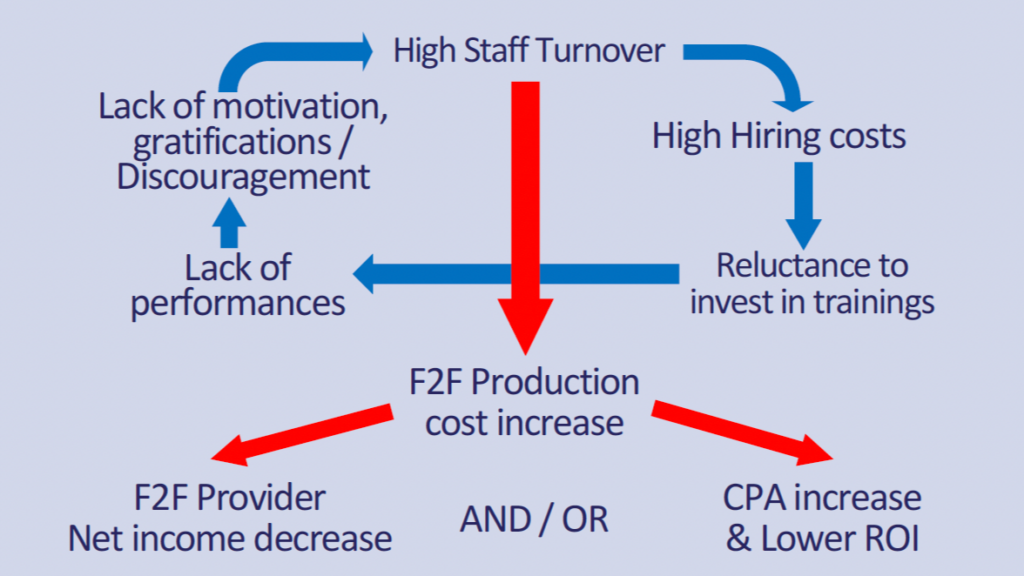
The vicious circle we keep reproducing
Across markets, geographies and organisational models, the same pattern repeats itself:
High staff turnover => higher hiring costs => reluctance to invest in training => weaker motivation and discourse quality => lower performance => higher CPA => increased pressure on ROI.
When this happens, the conclusion is often the same: “F2F is becoming too expensive.” In reality, what is becoming expensive is under-investment in people.
Why turnover quietly inflates CPA
F2F is a people-powered channel. Its performance depends on the quality of human interaction, not just volumes, locations or scripts.
High turnover does far more than increase recruitment costs:
- it erodes accumulated know-how,
- weakens message consistency,
- reduces credibility in donor conversations,
- and shortens the learning loops that improve performance over time.
Each new fundraiser starts again from zero. Each departure resets part of the system. The result is a hidden cost rarely captured by short-term KPIs: CPA inflation driven by the loss of experience, confidence and conversational quality on the field.
This is why markets with similar donor profiles and campaign conditions can show radically different CPA outcomes: the difference often lies in team stability, not demand.
Training is not an HR expense. It is a performance system
The quality of a fundraising conversation is not accidental. The ability to build trust in a few minutes, adapt a discourse, handle objections and represent a cause credibly is learned, coached and reinforced over time.
Yet when margins tighten, training is often the first budget line to be reduced. This may protect short-term financial optics. But it almost always accelerates long-term CPA inflation.
Well-designed training and coaching systems do the opposite:
- they improve retention by giving teams perspective and progression,
- they raise the quality and consistency of discourse,
- they stabilise performance across locations and time,
- and they reduce dependency on constant hiring.
In other words, training does not add cost to F2F. It protects value.
From cost containment to active performance management
F2F performance is rarely destroyed by excessive investment in people. It is far more often weakened by defensive cost-cutting that undermines the very mechanisms that make the channel work.
When training, coaching and professionalisation are treated as strategic levers rather than optional expenses, the equation changes:
- turnover decreases,
- learning compounds,
- CPA stabilises,
- and ROI becomes more predictable.
This is not an ideological position. It is a structural one.
A question for the sector
Training is not a cost line. It is a CPA management lever.
High CPA in F2F is rarely a market problem. It is far more often a people investment problem.
I’m curious to hear from F2F leaders and experts, NGOs and providers:
- Where have you seen sustained investment in training directly improve team stability, discourse quality and CPA outcomes?
- And where are we still under-investing out of habit, rather than evidence?
Because the future of F2F performance will not be decided by tighter controls alone, but by how seriously we choose to invest in the people who carry the channel every day.